This Copart guide for buyers covers what you actually need to know before placing a bid. Copart is a nationwide online auction where thousands of wrecked, recovered-theft, hail-damaged, and plain used vehicles sell every week. You don't need a dealer license to get in, but you do need to read a lot listing correctly, know the real cost, and respect the clock once you win.
What Copart is and what it sells
Copart runs physical storage yards across the US (and in other countries) and sells their inventory online. You bid from your phone or laptop; the vehicle sits at the yard until it's paid for and picked up.
Most cars come from insurance companies. When repairs approach or exceed a car's value, the insurer declares it a total loss, pays the owner, and sends the vehicle to auction. But insurance totals are only part of the picture. You'll also see:
- Recovered thefts, sometimes with very little damage.
- Hail, flood, vandalism, and fire vehicles.
- Repossessions, rental returns, and fleet units with normal wear.
- Dealer trade-ins and charity donations.
- Motorcycles, trucks, boats, RVs, and equipment.
So a car that needs one bumper and a car that's only good for parts can sit side by side. The listing is what tells them apart, and reading it well is where buyers make or lose money. If you're still picking a platform, compare this with our IAAI guide and the Copart vs IAAI breakdown.
How to read a Copart lot listing
Every vehicle has a lot number and a listing with photos and data. That listing is not an inspection. It's what the yard and the seller recorded at intake. Here's what each field means for you.
Primary and secondary damage
Primary Damage is the main damage the yard noted: front end, rear end, side, hail, water/flood, burn, mechanical, vandalism, normal wear, and so on. Secondary Damage is the next most visible issue.
These labels describe what's visible, not what's underneath. "Front end" can mean a cracked bumper cover, or it can mean a radiator, deployed airbags, and a bent frame rail. Our article on auction car damage types explains what usually hides behind each category.
Sale document (title)
The Sale Document field tells you which paperwork you'll receive and which state issued it. Common ones:
- Clean title.
- Salvage certificate / salvage title: a total-loss vehicle that must be repaired and inspected before it's road-legal again.
- Certificate of destruction or parts-only documents: in many states these can never be titled for the road.
- Other state-specific documents (rebuilt, junk, bill of sale, and more).
The document decides whether you can register or export the car, and it can change the fees too. Before you fall for a lot, read what a salvage title really means and confirm that paperwork works for your plan.
Odometer
You'll see the mileage plus a status: actual, exceeds mechanical limits (the odometer rolled over), not actual, or exempt (older vehicles that don't require a mileage statement). Anything other than actual hurts resale value. Cross-check it with a vehicle history report by VIN.
Keys
The Keys field says whether the yard has a key. "Yes" doesn't promise the key starts the car or that there's a spare. "No" means you'll need one cut and programmed, which isn't cheap on newer models. Some carriers also charge more to haul a keyless car.
Run and Drive, Engine Start, and stationary
Copart puts these in the listing's Highlights:
- Run and Drive: at intake, Copart verified the vehicle started, went into gear, and moved forward under its own power.
- Engine Start Program: at intake, the engine started and idled, but movement wasn't verified.
- No start indicator, or doesn't start: treat it as stationary, meaning a non-runner.
None of these is a guarantee. Copart itself says the vehicle may not start on pickup day. Batteries die and damage gets worse in storage. Treat the flags as clues, not certificates.
Other highlights
You may see labels like Enhanced Vehicles (the seller requested services such as a wash or protective cover, with no promise they were done), fleet or lender units, and sometimes an engine video. Read each definition on the listing itself, since Copart updates them.
Location and sale date
Location matters more than most first-time buyers expect. The yard and state drive your towing cost to your home or shop, the title rules that apply, and sometimes whether the public can bid at all. The sale date tells you when preliminary bidding closes and when that yard's live auction starts. If it says "future" or has no date, the lot hasn't been scheduled yet.
VIN, ACV, and estimated repair cost
The VIN unlocks the car's history. Some listings show an actual cash value (ACV) and an estimated repair cost. Both come from the seller side and are rough references, not shop quotes. Don't set your bid off those numbers alone.
For a full pre-bid checklist, use how to inspect an auction car before bidding.
Copart sale types
Copart mixes several formats. Knowing which one you're in saves you surprises.
Preliminary bidding (pre-bid)
In the days before the auction you can place a preliminary bid. It works as your maximum: the system bids for you in increments up to that cap. The highest preliminary bid becomes the starting point of the live sale.
Virtual live auction
On sale day each yard runs its online auction, and lots sell one after another, sometimes in seconds. If your max is already in, you compete automatically. If you want to bid live, you need to be online with your limit decided. We walk through it step by step in how Copart bidding works.
Buy It Now
Some lots carry a fixed Buy It Now price. Pay it before the auction and the car is yours with no bidding war. Convenient, yes, but not always the best price, so compare it with what similar cars have sold for.
Pure Sale, On Approval, and minimum bid
- Pure Sale: no reserve. The car sells to the highest bid, whatever it is.
- On Approval or Minimum Bid: the seller set a floor or kept the right to approve. If the winning bid falls short, they can accept it, reject it, or counter.
Winning an On Approval lot means you're not done yet. Your deposit may stay on hold while the seller decides.
Copart fees: what you pay on top of the bid
Your winning bid is never your final price. Copart adds fees that depend on the sale price, title type, whether the buyer is licensed, and how you pay. These are the reference figures RCA uses (Copart's schedule for secured payment and a non-clean title). They can change at any time, so treat them as a guide, not a quote.
| Fee | What it covers | Reference |
|---|---|---|
| Buyer fee | Main purchase fee, tiered by price | e.g. $860 on an $11,900 purchase; 6% from $15,000 up |
| Virtual bid fee | Fee for bidding online | Up to $160 |
| Gate fee | Handling the car out of the yard | $95 |
| Environmental fee | Environmental charge | $15 |
| Title mailing fee | Shipping the title | $15 |
Then add the costs Copart doesn't charge but you still pay: broker fee, towing, storage if you're late, paperwork, and repairs. If the car stays in the US, add your state's sales tax, title, and registration; if you export it, add freight and the destination country's taxes. For the full picture, see the true cost of auction cars, or run your own numbers in the auction cost calculator.
Sample budget
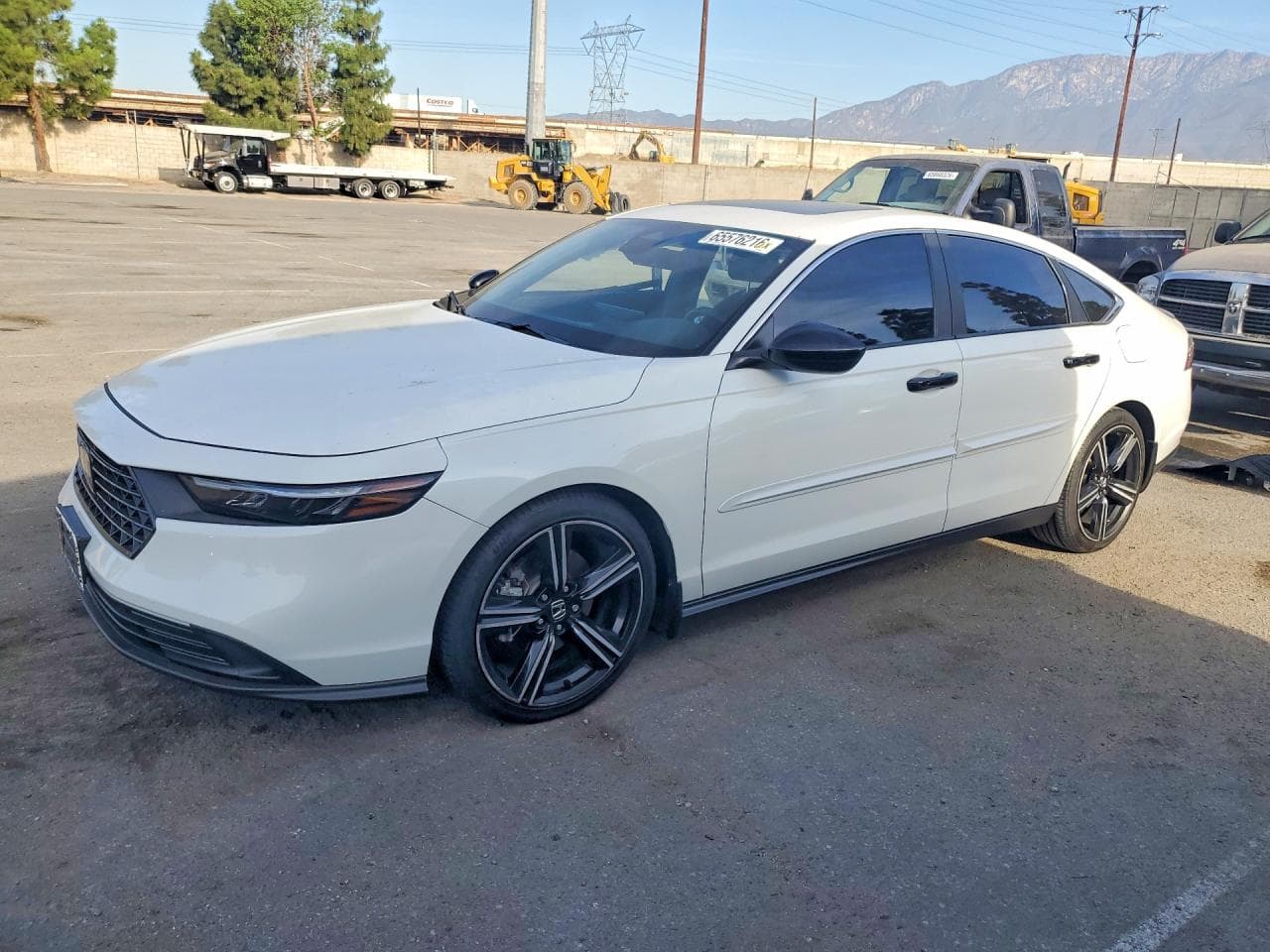
A 2023 Honda Accord Sport Hybrid from Copart with side damage and a California SALVAGE CERTIFICATE (example only):
| Item | Amount |
|---|---|
| Purchase price | $11,900 |
| Buyer fee | $860 |
| RCA broker fee | $500 |
| Towing | $650 |
| Approximate auction total | ≈ $13,910 |
This shows how the number comes together; every lot is different. That total covers only the purchase and the tow. If you keep the car in the US, add your state's sales tax, title, and registration, plus repairs. If you export it, add freight and the destination country's taxes; for the DR, a salvage car also needs a rebuilt title before it ships.
Membership and licensing: why many buyers use a broker
To bid directly you need a Copart membership. But membership doesn't unlock everything. Many lots are restricted to licensed dealers, and the rules shift with the state where the car sits and the title type. Some clean-title cars are open to the public; many salvage and parts-only lots aren't, at least in certain states.
That's where a broker comes in. RCA Auto Broker bids for you through an account that has access to those lots, so you don't need a dealer license to place an offer. One caveat: buying through a broker doesn't change your state's rules on what you can do with the car afterward, whether that's titling, repairing, or exporting it. That's why we go over the paperwork with you before you bid. The full walkthrough is in how to buy from Copart without a dealer license.
Payment, pickup, and storage deadlines
Once you win, the clock starts. In general terms:
- Payment: Copart allows only a few business days to pay in full, fees included. Miss it and you may face late fees or a canceled sale.
- Pickup: after payment you get a few more days to get the car off the lot.
- Storage: if it's still there after that, daily storage charges kick in.
Deadlines and amounts vary by yard, country, and sale type, and Copart can change them. The practical rule: have transport quoted before you bid, especially if the car is in another state and you need a tow or a carrier.
How to buy from Copart through RCA
With RCA you don't open a Copart account or fight the live auction yourself. It all runs from the web app (app.rcaautobroker.com, opens in your browser, nothing to download):
- Find the lot in the Copart + IAAI search, filtered by year, price, mileage, damage, title type, keys, and location.
- Review the listing: photos, primary and secondary damage, sale document, location, and a transport quote if you need one.
- Pull a vehicle history report by VIN and build your total budget in the calculator.
- Submit your max bid with a deposit: the greater of $1,000 or 10% of your max. If you're outbid, the deposit goes back to your balance.
- Follow your offer with bid tracking: Received → In offer → Bid sent → Won / Outbid.
- If you win, you pay for the lot and we coordinate ground transport through RCA Transport and the lot's paperwork.
RCA's broker fee is based on the final price: $250 up to $5,000; $350 from $5,001 to $10,000; $500 from $10,001 to $20,000; $700 from $20,001 up (Dealer plan members pay $50 less).
If you're exporting
If the car won't stay in the US, the Copart side works exactly the same until you win. What changes is everything after: confirming the sale document allows export, moving the car from the yard to the port, ocean freight, customs, and the destination country's taxes. RCA can coordinate that leg too. If the car is headed to the Dominican Republic, the full process is in our guide to importing a car from the USA to the Dominican Republic.
Tips for buying smarter on Copart
- Set your max bid from the total cost, not the hammer price. Work out fees, towing, repairs, taxes, and registration (or freight, if you export) first; what's left is your ceiling.
- Look at every photo, including interior, dash, and engine bay. Watch for deployed airbags, water lines on the carpet, and warning lights.
- Check past sale prices on similar vehicles so emotion doesn't set the price.
- Favor yards near you or your shop: cheaper towing and faster delivery.
- Keep a backup list. Lose one lot and similar ones show up next week.
Common mistakes that cost real money
- Treating "Run and Drive" as a warranty. It's what the yard saw at intake, nothing more.
- Skipping the sale document. A certificate of destruction can keep the car off the road for good.
- Missing deadlines. A couple of late days can pile on storage and penalties.
- Bidding live with no ceiling. Auctions move fast and adrenaline pushes prices up.
- Underestimating repairs. The listing's estimated repair cost is not a shop estimate.
New to all of this? Start with how to start buying at auction, keep the auction glossary open, and read our overview on how to buy auction cars.
The bottom line
Copart can be a great source of well-priced vehicles, but only if you read the listing carefully: damage, sale document, odometer, keys, highlights, location, and sale type. The bid is just the starting number. What matters is the total cost with fees, transport, repairs, and taxes, and the payment and pickup deadlines are strict.
RCA Auto Broker works as the go-between for you and the auction. You search Copart and IAAI in the app, bid without a dealer license, and we track your car until it leaves the yard. Before you bid, run your numbers in the auction cost calculator.
Frequently asked questions
What is Copart and what does it sell?
Copart is one of the largest online vehicle auction platforms in the US. Most of its inventory comes from insurance companies after a total loss, but it also sells repossessions, fleet and rental units, dealer trade-ins, and donated vehicles.
Can I buy from Copart without a dealer license?
Some lots are open to the public depending on the state and title type, but many require a license. Through a broker like RCA Auto Broker you can bid without a dealer license from any US state.
What does 'Run and Drive' mean on Copart?
It means that when the vehicle arrived at the yard, Copart verified it started, went into gear, and moved under its own power. It is not a mechanical guarantee, and the car may not run the same way on pickup day.
What is the difference between Pure Sale and On Approval?
A Pure Sale lot sells to the highest bidder with no reserve. An On Approval or minimum-bid lot lets the seller accept, reject, or counter the winning bid, so winning the auction doesn't always mean you bought the car.
How much are Copart fees?
They depend on the final price, title type, and payment method. As a reference, RCA uses an $860 buyer fee on an $11,900 purchase, a virtual bid fee up to $160, a $95 gate fee, a $15 environmental fee, and a $15 title mailing fee. Fee schedules change.
How long do I have to pay for and pick up a Copart vehicle?
Copart gives a short window of business days to pay and then to remove the vehicle before daily storage charges start. Exact deadlines vary by yard and can change, so line up transport before you win.
Is the Copart odometer reading accurate?
It's the reading recorded at intake, labeled as actual, exceeds mechanical limits, not actual, or exempt. Always cross-check it against a vehicle history report pulled by VIN.
Ready to look at real lots?
Search Copart and IAAI, see the total cost with our fee in plain sight, and track your bid from the app.